

Jan 13, 2026
San Jose, CA (USA)
Author:Debi Prasad Sahoo , Founder & CTO, NetFin
Co-Author:Swagatika Priyadarshini , Global Solution Specialist, NetFin
Summary
This paper examines structural limitations inherent in prevailing market benchmarks and introduces a new, conceptually grounded framework designed to improve representativeness, reduce concentration risk, and enhance the informational value available to investors across generations. Conventional market-cap–weighted indices disproportionately emphasize a small cluster of very large firms, limiting investors' ability to understand the broader cross-section of economic activity and restricting the visibility of high-potential mid-sized and emerging companies. These concentration effects not only reduce the diversity of investment opportunities but also distort signals about macroeconomic health and impede growth at the firm level.
Using a multi-dimensional construction methodology, we propose a benchmark that integrates broader firm representation, dynamic weighting mechanisms, and fundamental-adjusted inclusion criteria. The framework aims to provide a more stable reference point in volatile markets, facilitate opportunity discovery for new and experienced investors, and support the long-term development of companies that play a critical role in innovation and job creation. Our findings contribute to the literature on benchmark design, capital allocation, and index efficiency by offering an alternative architecture aligned with the economic structure of modern markets.
Abstract
We're publishing this paper to share with the world our research on a noble approach that uses resilience as a seed to unleash economics at scale with a highly elastic benchmark.
We're sharing our findings on some of the key limitations with prevailing benchmarks and a noble approach to solve not only the limitations, but also to unleash investment opportunities with scale and create opportunities of growth for billions of people across the globe.

The proposed inclunomics benchmark is built with the principles of meeting aspirations for various generations, from Baby Boomers to Gen Beta and beyond.
Introduction
Research Background and its Objective:
Existing Benchmark:
When focus is given to selective group of companies, It limits the scope of understanding the world surrounding us. So also the scope of growth of many other promising entities and scope for individuals who don't have access or choice to consider investing in those entities. At a macro level, exiting benchmarks have this problem whereby benchmark is tilted to companies dominating by the market cap weighted distribution. Strength of an economy can not be measured by top 10 or top 20 of the companies of even though the benchmark has public companies in hundreds. At a micro level, these benchmarks have adverse effect on small and medium businesses that have potential of becoming bigger generating new jobs, enhancing employee satisfaction and shareholders experience.
NetFin Benchmark:
With our approach, the benchmark comprises of set of dynamic benchmarks called inspirational benchmarks. Aggregating the mechanism of dynamic indices, NetFin benchmark
Macro and Micro Analysis:
implications at both the macro and micro levels. At the macro level, the strength of an economy cannot be inferred from the performance of its largest firms alone. An index dominated by 10 or 20 companies—even when it contains hundreds—fails to capture the dynamism of small and medium enterprises (SMEs) that contribute substantially to innovation, employment, and regional growth. At the micro level, benchmark concentration reduces visibility and capital flows to emerging companies, limiting their ability to scale, generate new jobs, improve employee outcomes, and deliver returns to shareholders. When benchmarks serve as the primary filter through which investors allocate capital, this structural imbalance can reinforce inequality in opportunity across firms.
These limitations are particularly salient for new generations of investors. Many first-time investors rely on benchmarks as a guide to understand markets, evaluate performance, and identify opportunities. However, benchmarks that reflect only a narrow subset of firms may unintentionally limit awareness of broader investment possibilities, especially in volatile market environments where clear guidance is essential.

Opportunities with NetFin Benchmark
- Dynamic (New Additions)
- Access to Various Investment Instruments

- Access to Local Opportunities
- Access to International Opportunities

Benefits of NetFin Benchmark
- Investing in high-conviction Investment Ideas
- Saving Research Time

- More Leisure Time
- Positive Social Impact

References:
- Stock Market Indices
- TROVA MIS
- TROVA ESG
Sample Results
Performance Comparison Analysis
For sample reference, we did performance comparison of two not so well-known stocks that are part of NetFin benchmark and two heavyweights (referred as HW1 and HW2) from an existing 3rd party benchmark that is followed in the financial market for investments.
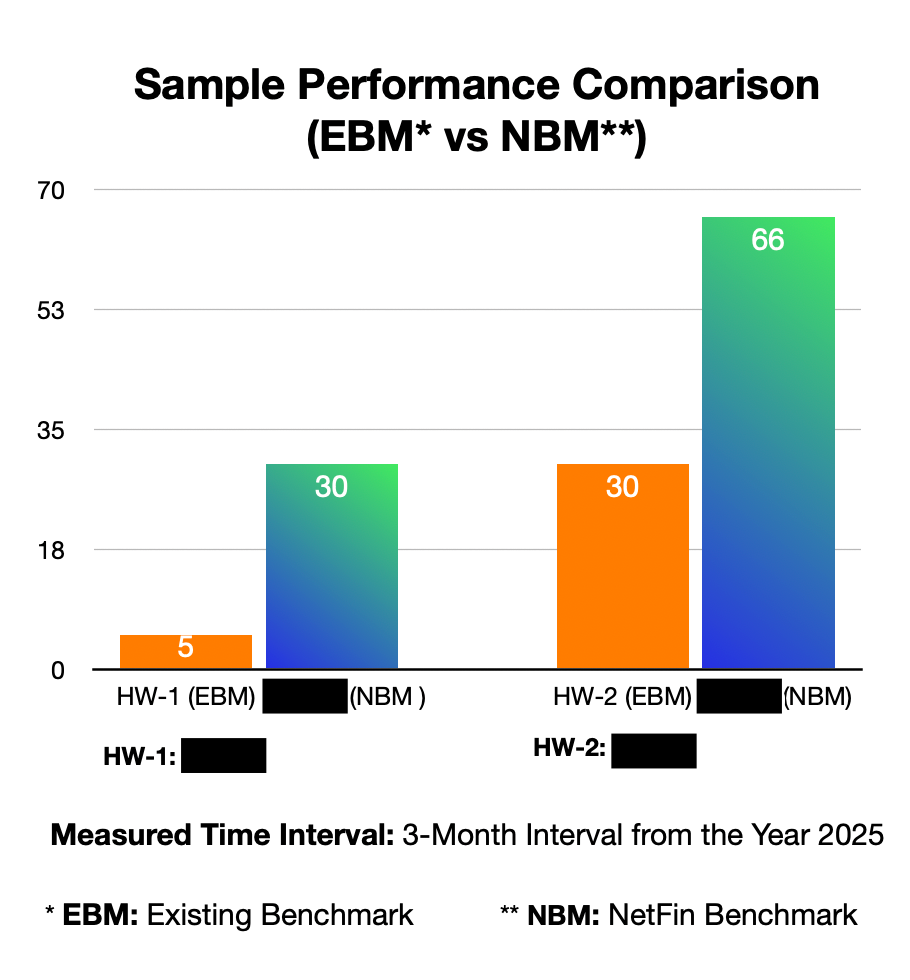
Note: Numbers in the performance chart represent ROI (Return On Investment) in % .
To know the name of these two firms from NetFin benchmark that Outperformed the heavyweights of the existing 3rd party benchmark in the measured time interval, login to TROVA and then read the full article at the blogs page.